
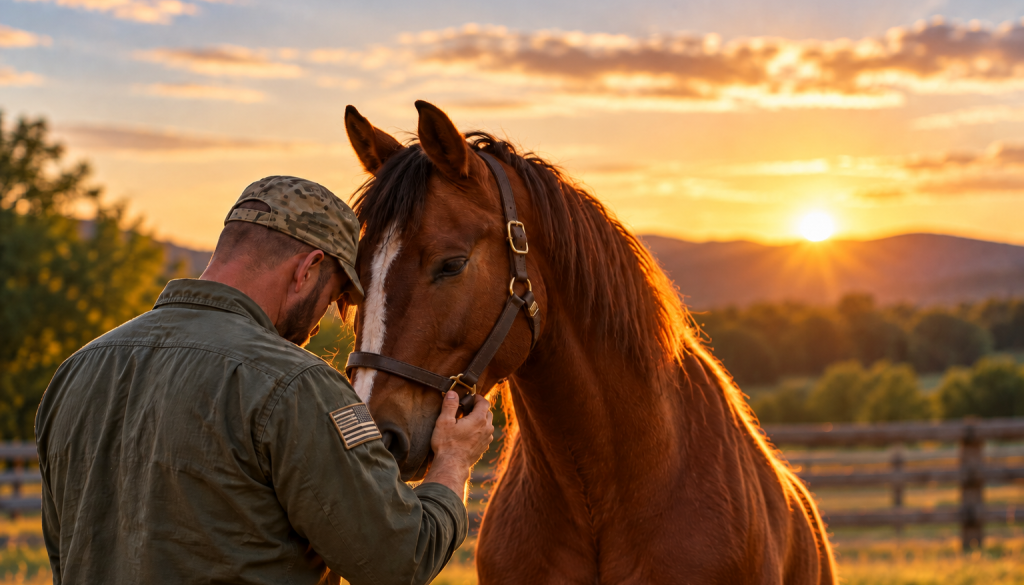
Why Horses Can Be Powerful Partners for Veterans
How routine, trust, emotional regulation, confidence, and time at the ranch can create meaningful opportunities for healing
For many veterans, returning home does not mean every part of the battle is over.
Military service can leave experiences that are difficult to explain to people who have never lived them. Some veterans face post traumatic stress, anxiety, depression, difficulty trusting others, isolation, or the challenge of adjusting to a life that no longer has the same structure and sense of mission they once knew.
Not every veteran experiences these challenges, and there is no single approach that is right for everyone. But for some veterans, connecting with a horse can create a different kind of environment for healing.
There is no pressure to find the perfect words.
There is a horse standing in front of you. There is a task to complete. There is a relationship to build.
And sometimes, that is a powerful place to begin.
At Bluebird Equine Therapeutic Ranch, veterans are among the people we welcome into an environment centered around horses, nature, professional support, and meaningful human connection. You can learn more about the experiences available through our Our Programs page.
Why the Connection Between Veterans and Horses Matters
The connection between veterans and horses has attracted increasing attention from clinicians, researchers, Veterans Affairs programs, and equine assisted service organizations.
There is good reason for that interest.
According to the U.S. Department of Veterans Affairs, about 7 out of every 100 veterans will experience PTSD at some point in their lives. Rates vary considerably depending on service era, deployment history, trauma exposure, gender, and other factors.
The VA also reports that among veterans who served in Operations Iraqi Freedom and Enduring Freedom, the lifetime prevalence of PTSD is approximately 29 percent.
That does not mean horses are a cure for PTSD, nor should equine assisted services be presented as a replacement for appropriate mental health care.
What research increasingly suggests, however, is that structured experiences with horses may offer meaningful benefits for some veterans, particularly as a complementary form of support.
A 2024 systematic review published in the Journal of Veterans Studies examined 13 studies involving 344 participants and found that studies reporting PTSD scores showed an average 22.6 percent reduction in PTSD scores following equine assisted services. The researchers concluded that equine assisted services appeared to have a positive influence on PTSD symptoms, while also emphasizing that most of the available studies had methodological limitations and that more rigorous research is needed.
That distinction matters.
The science is promising, but the relationship between a veteran and a horse is about more than a number on a research study.
It can begin with something as simple as showing up.
Routine Can Create a Sense of Purpose
Horses thrive on consistency.
They need to be fed. They need grooming and care. Equipment has to be checked. Their environment must be maintained. Working with them requires attention to what is happening in the present moment.
For a veteran who was accustomed to a military life built around schedules, responsibilities, teamwork, and defined objectives, that kind of routine can feel familiar.
Caring for a horse gives the day a purpose.
- There is someone waiting for you.
- There is something that needs to be done.
- There is a reason to get involved.
The tasks themselves may appear simple, but feeding, grooming, leading, and caring for a horse can create opportunities to rebuild consistency one step at a time.
Trust Is Earned Without Having to Say Much
Trust can be difficult after trauma.
Horses offer a relationship that does not begin with a conversation about what happened during military service. They do not ask someone to explain their past before interacting with them.
Trust develops through behavior.
A person learns how to:
- Approach the horse calmly
- Respect its boundaries
- Communicate clearly
- Remain consistent
- Recognize the horse’s responses
In a Houston VA story about equine assisted therapy, Dr. Shannon Sisco, who has served as Whole Health Coordinator with the Houston VA, explained an important part of that process:
“The challenge in equine therapy is to develop a trusting relationship with your horse, which in many ways brings out lessons about our own relationships.”
Those lessons can extend beyond the ranch.
Building trust with a horse can provide an opportunity to practice patience, communication, boundaries, and consistency in a setting where progress often happens through actions rather than words.
Judy Smith, director of Equine and Human Science at Utah State University, described another advantage in a Veterans Affairs feature on equine assisted therapy:
“Through the relationship with the horse … it gives Veterans a chance to explore relational skills in a very relaxed environment.”
That relaxed environment can be especially meaningful for someone who may not initially feel comfortable sitting across from another person in a traditional office.
Horses Encourage Awareness of the Present Moment
Working safely with a horse requires attention.
A veteran may need to notice:
- Where the horse is standing
- What its body is communicating
- How quickly they are moving
- Whether they are tense
- Whether they are frustrated
- Whether they are distracted
The veteran has to notice what is happening right now.
That process can encourage greater awareness of breathing, movement, tension, tone, and emotional reactions.
In a Veterans Affairs article about an equine therapy program in Milwaukee, VA social worker Briana Johnson described how veterans are encouraged to become more present because horses respond to body language and changes in behavior. The program uses activities such as grooming and guiding horses through obstacles to help participants work on:
- Confidence
- Mindfulness
- Boundaries
- Trust
Research has also explored these effects.
A randomized pilot study of an eight week adaptive horsemanship program involving veterans with PTSD found encouraging changes in PTSD related measures and human animal interaction scores. Because the study was small, the researchers appropriately described the findings as preliminary rather than definitive.
That is an important part of understanding this field. Emotional regulation is complicated, and horses are not a shortcut around professional mental health treatment.
What they can provide is another setting in which those skills can be practiced.
Small Successes Can Help Rebuild Confidence
A horse is a large, powerful animal.
For someone without much experience around horses, simply approaching one may initially feel intimidating.
Then something changes.
- The veteran successfully leads the horse.
- The horse responds to a cue.
- A grooming session becomes comfortable.
- A new skill that seemed difficult becomes familiar.
Those moments matter.
Confidence is not always rebuilt through one dramatic breakthrough. Sometimes it returns through a series of smaller experiences that remind someone, I can do this.
One study of 63 treatment seeking veterans with PTSD found significant reductions in clinician rated and self reported PTSD symptoms after an equine assisted therapy program.
About 50.8 percent of participants experienced a clinically significant reduction in PTSD symptoms immediately following treatment, and approximately 54 percent experienced a clinically significant reduction at the three month follow up.
Another randomized study of therapeutic horseback riding for veterans with PTSD found significant decreases in PTSD scores after both three and six weeks of participation. The study also examined coping and emotional regulation. Those additional outcomes moved in the expected direction but did not reach statistical significance, another reminder that the evidence should be viewed with both interest and appropriate caution.
The goal is not to promise a particular outcome.
It is to create opportunities for progress.
The Ranch Can Offer Something an Office Cannot
There is also something important about the setting itself.
A ranch moves at a different pace.
There is:
- Open space
- Animals to watch and care for
- Fresh air
- Natural sounds
- Grass and dirt underfoot
- Movement
- Room to slow down
For someone who spends much of life surrounded by phones, buildings, traffic, appointments, and constant stimulation, time around horses and nature can feel different.
That was part of Teah Pearson’s own inspiration for Bluebird.
As Teah explains:
“I want to be able to give that same hope and help to others.”
Her vision for Bluebird is rooted in the belief that healing can take many forms and that nature, animals, peaceful environments, meaningful relationships, and professional therapeutic support can all have a place in that process.
Learn more about Teah, Ed Green, and the people behind the ranch on our Meet Our Team page, or read more about the mission behind Bluebird on our About Us page.
Professional Support Still Matters
The horse may be an important part of the experience, but the people surrounding that experience matter too.
At Bluebird, therapeutic support and horse related activities have distinct professional roles:
- Licensed clinicians provide therapy.
- Experienced horse professionals guide interactions and activities involving the horses.
That combination allows the experience with the horse to take place within a thoughtful and supportive environment.
Ed Green, Clinical Director, says:
“Sometimes progress begins with feeling safe enough to be present. Horses can help create that space without requiring someone to have all the right words.”
Ed brings more than 25 years of behavioral health experience to Bluebird. His clinical perspective helps ensure that the human side of the experience receives the same attention as the interaction with the animals.
Promising Research and a Very Human Connection
Researchers are still learning why equine assisted services appear to help some veterans.
A 2021 review of equine assisted activities and therapies for veterans with PTSD described the field as promising for symptom reduction and wellbeing but stressed the need for standardized approaches and stronger randomized controlled trials before definitive conclusions can be reached.
That is where the evidence currently stands.
- Promising
- Growing
- Worth studying carefully
But anyone who has watched a person slowly earn the trust of a horse also understands that some of the most meaningful moments are difficult to reduce to statistics.
It may be:
- The first time a veteran relaxes around an animal
- The first time the horse willingly follows
- The first time someone realizes that frustration does not have to control the next decision
- The first time a person feels responsible for something again
- The first time someone who has been carrying everything alone begins to connect
Horses cannot erase what a veteran has experienced.
But they can sometimes become powerful partners in what comes next.
Learn More About Bluebird Equine Therapeutic Ranch
If you are a veteran or family member interested in learning more, we invite you to explore Our Programs or contact Bluebird Equine Therapeutic Ranch to start a conversation.
You do not need previous experience with horses to take the first step.
For those who would like to help make these experiences available to veterans, children, families, and others in our community, you can also support the ranch through our Donate page.
Sometimes healing begins with a conversation.
Sometimes it begins in a quiet pasture beside a horse.